PROJECT OVERVIEW
Rolekick is an internal HR management platform designed to help companies manage onboarding, performance, engagement, and development in one structured system, supported by an AI powered coaching assistant.
The company already had a subsidiary application called WeThrive, focused primarily on engagement.
However, leadership wanted to build a new web application that went beyond engagement and positioned the product as a full performance and strategy alignment platform. The ambition shifted from: “Measure how people feel” to “Understand how people contribute to company strategy.” That shift defined the entire project.
Some UI details and exact metrics are abstracted due to NDA.
PROJECT TYPE
Web first, mobile supported
TIMING
3Months
ROLE
Snr UX UI Designer, Researcher
TOOLS
Figma, Miro, FigJam, Notion
PROBLEM
I led structured stakeholder interviews with founders, HR leaders, and operational managers. Each session explored where execution breaks down, how performance is tracked, and which signals remain invisible to leadership.
The organization was facing structural friction:
• Employee data spread across multiple tools
• Goals disconnected from feedback and engagement signals
• Managers inconsistent in coaching due to lack of structure and time
• HR unable to demonstrate clear business impact
• Executives lacking visibility into performance and risk
SOLUTION
Rolekick was designed as a performance operating system built around five pillars:
Strategy clarity
Goal alignment and tracking
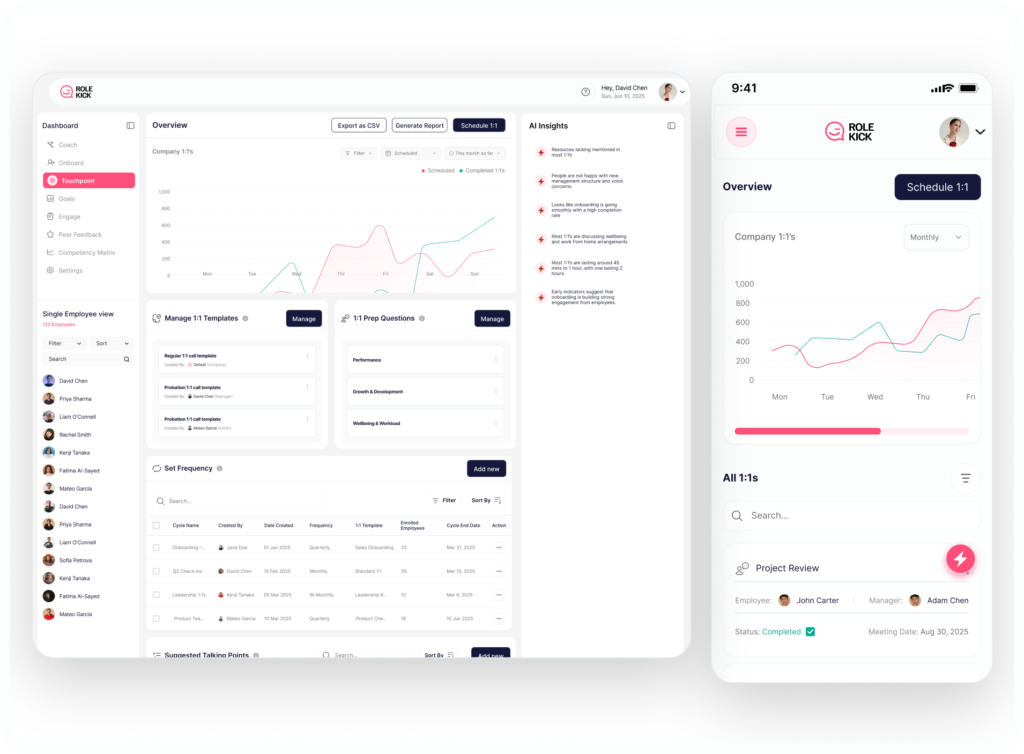
Continuous feedback and touchpoints
Talent development through skill visibility
AI assisted insights and decision support
PROJECT KICKOFF
When I joined the project, the company already had WeThrive, a subsidiary application focused primarily on engagement surveys and sentiment tracking.
It was working. But leadership was feeling a ceiling. Engagement data was useful, yet it wasn’t driving performance conversations. It wasn’t connecting to goals. It wasn’t showing executives how daily work tied back to strategy.
The kickoff phase wasn’t about designing screens. It was about redefining the product.
Step 1 — Clarifying What This Product Is Not
At kickoff, the company already had WeThrive, an engagement focused product. The goal was to build a new web application, but the scope wasn’t clearly defined.
Through Zoom workshops and ongoing Slack discussions, we aligned on one key decision: This could not be just another engagement tool. WeThrive measured sentiment well. What was missing was performance visibility and alignment to strategy. We agreed the new platform needed to go beyond surveys and become a structured performance system.
Step 2 — Defining the Real Problem
Through internal conversations with stakeholders and product leads, we identified the core tension:
• Engagement data existed, but wasn’t connected to goals
• Managers lacked structured visibility into performance
• Leadership couldn’t clearly see what teams were working on
The issue wasn’t collecting more data. It was connecting execution to strategy.
Step 3 — Mapping the Employee Lifecycle
Instead of listing features, we mapped the actual employee journey:
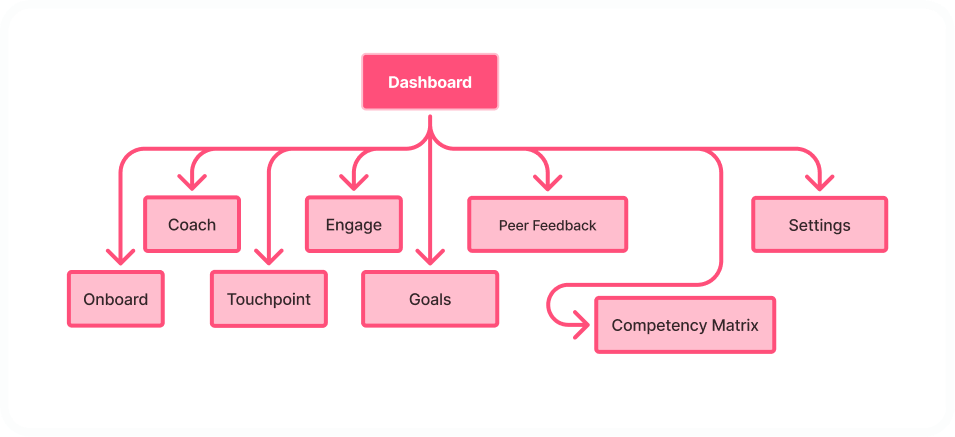
Onboard → Set Goals → Run Touchpoints → Give Feedback → Measure Engagement → Develop Skills
This exposed fragmentation. Engagement was only one stage in a broader performance loop.
That lifecycle became the backbone of the product architecture and navigation.
positioning shift
By the end of kickoff, the direction was clear: We were not building WeThrive 2.0. We were building a performance clarity system that makes work visible, measurable, and aligned.
DESCOVERY & RESEARCH
Research was primarily internal, supported by the team’s product context from WeThrive and ongoing stakeholder input. We conducted:
Competitive analysis with stakeholders
Workflow mapping sessions focused on HR and manager pain points
MVP definition based on development constraints
Finding One, HR Tools Are Fragmented
HR workflows were split across tools, creating inefficiency and gaps in visibility.
Finding Two, Engagement Alone Does Not Drive Decisions
Sentiment is useful, but without goals and performance context it does not translate into action.
Finding Three, Managers Need Support, Not More Dashboards
Managers need structure, prompts, and fast answers, which led directly to AI coaching integ
IDEATION
Ideation centered on reducing complexity while increasing clarity.
Key decisions:
Organize navigation by employee lifecycle, not by feature categories
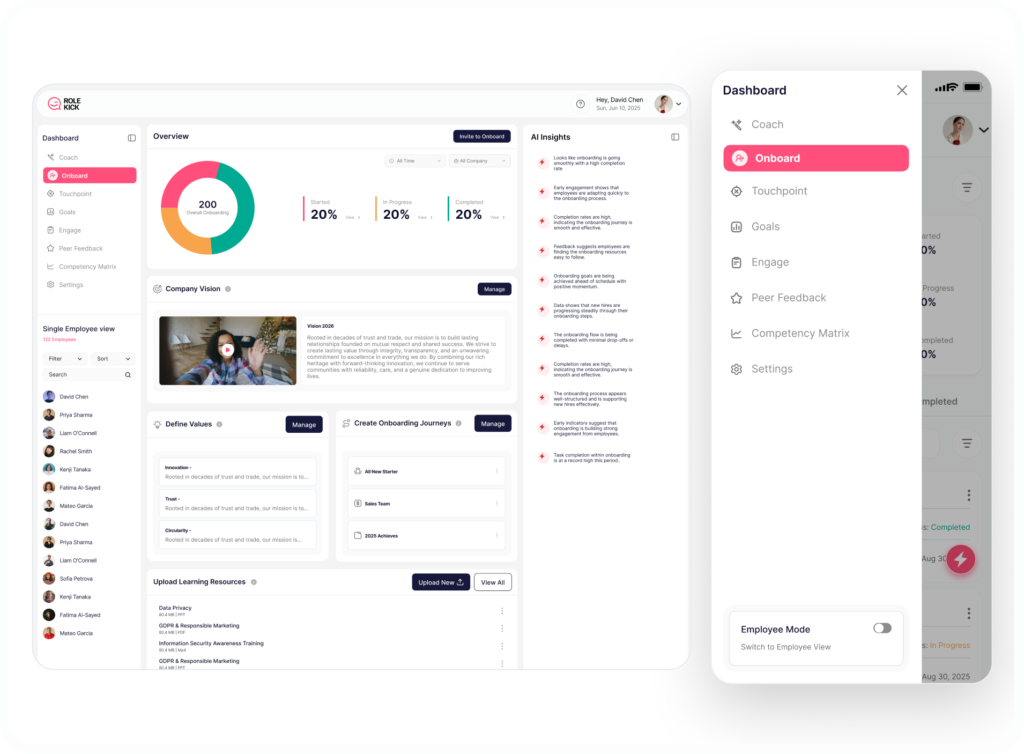
Separate views and permissions by user role
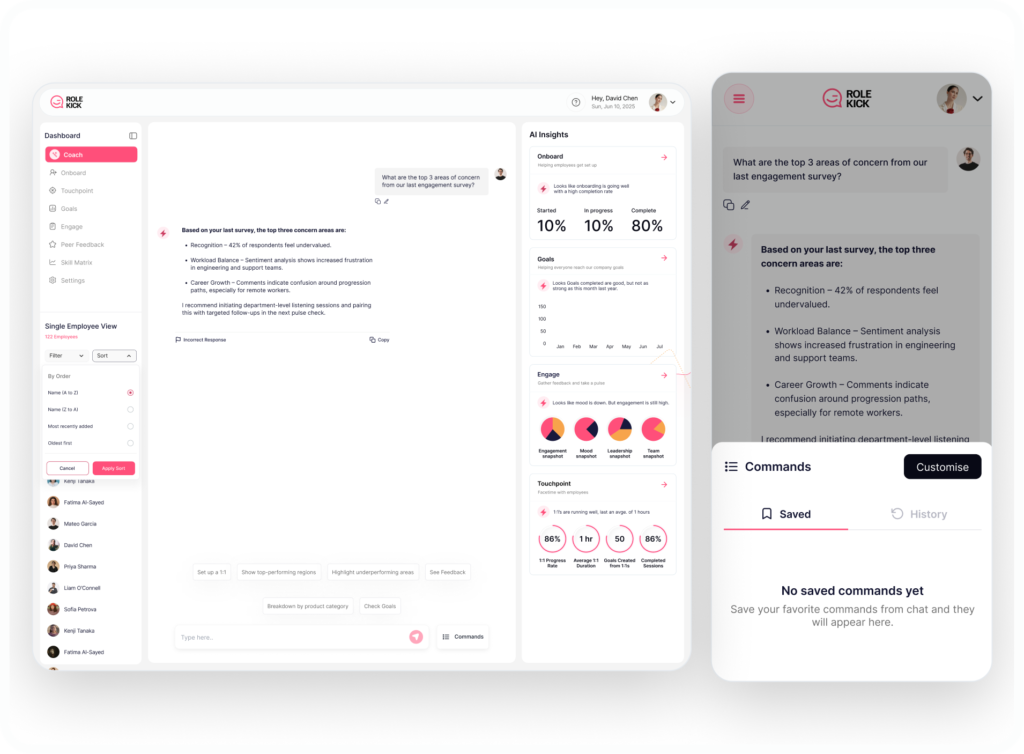
Design AI as a contextual assistant, not a standalone chatbot
Prioritize an MVP that delivers value early while preserving scalability
DEFINING USER ROLES
Ideation centered on reducing complexity while increasing clarity.
Key decisions:
Organize navigation by employee lifecycle, not by feature categories
Separate views and permissions by user role
Design AI as a contextual assistant, not a standalone chatbot
Prioritize an MVP that delivers value early while preserving scalability
HR Admins
Setup, oversight, dashboards, survey cycles, employee records, reporting
Managers
Goals, touchpoints, feedback, coaching support, risk visibility
Employee
Onboarding, personal goals, surveys, feedback participation, growth visibility
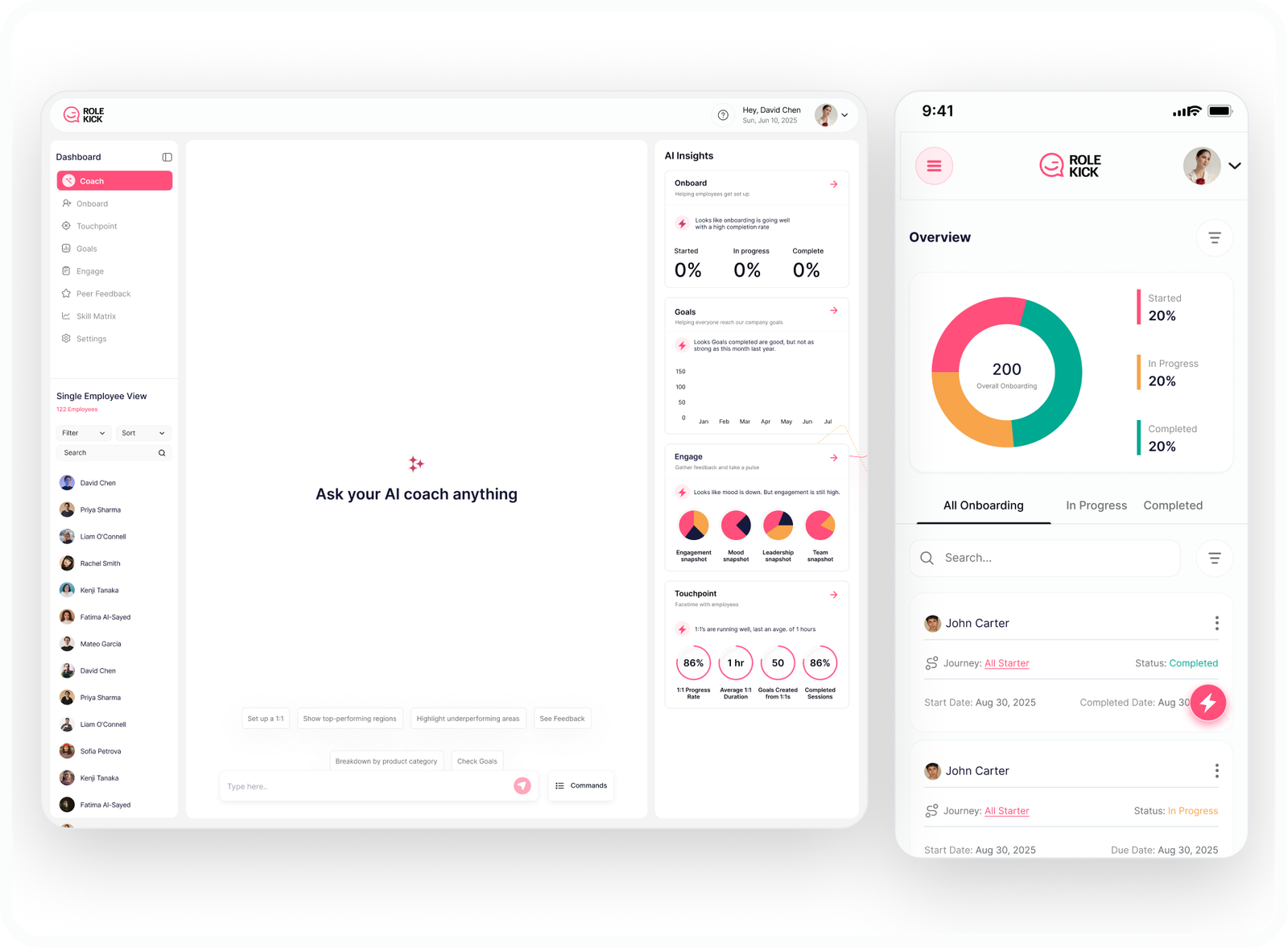
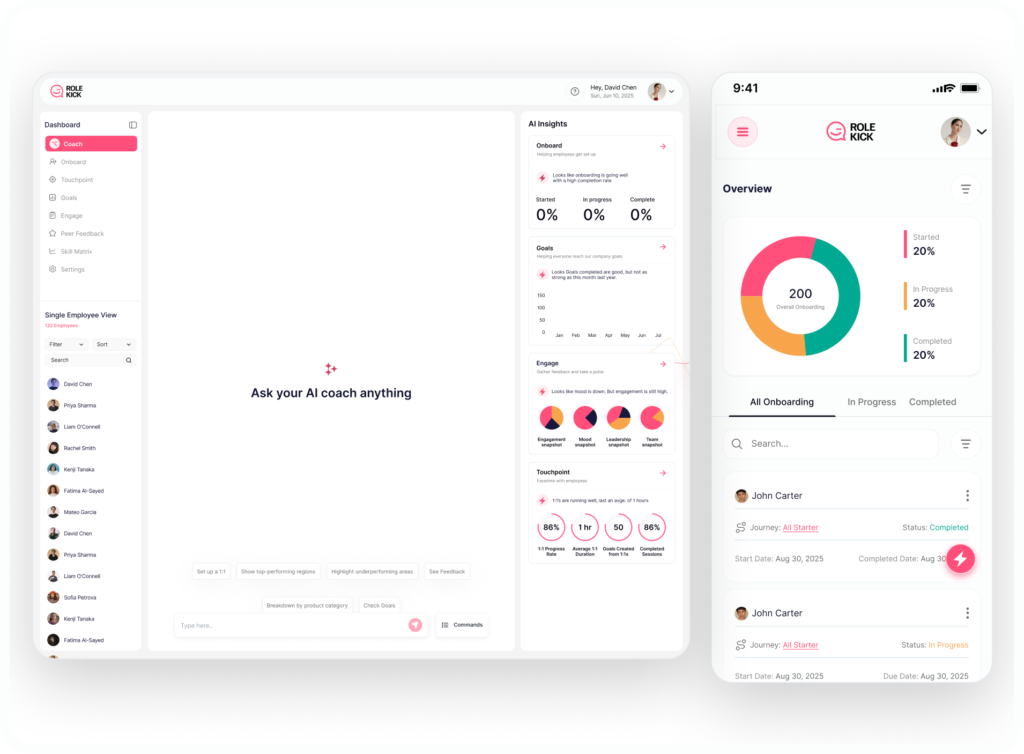
Designing the AI Coach
The AI coach was designed to support managers and HR teams with contextual insight across the employee lifecycle.
It enables users to ask:
1. Which employees are at risk this quarter
2. Show goal completion trends
3. Highlight underperforming teams
4. Summarize engagement changes
Design considerations:
1. Suggested prompts for fast start
2. Clear hierarchy and scannability
3. Trust driven tone and structure
4. Minimal visual noise
Web and Mobile Strategy
Rolekick was designed for both web and mobile, but intentionally not identical.
Web had a full management capabilities, setup, dashboards, goal creation, survey management, reporting.
The Mobile Action focused tasks, check ins, touchpoints, goal viewing, lightweight updates and feedback responses We restricted mobile functionality intentionally because the product is large and complex, and full parity would create friction and reduce usability.
Iteration and Improvements After Feedback
As development progressed, internal feedback highlighted the need for better clarity and development tracking.
Two major improvements were introduced:
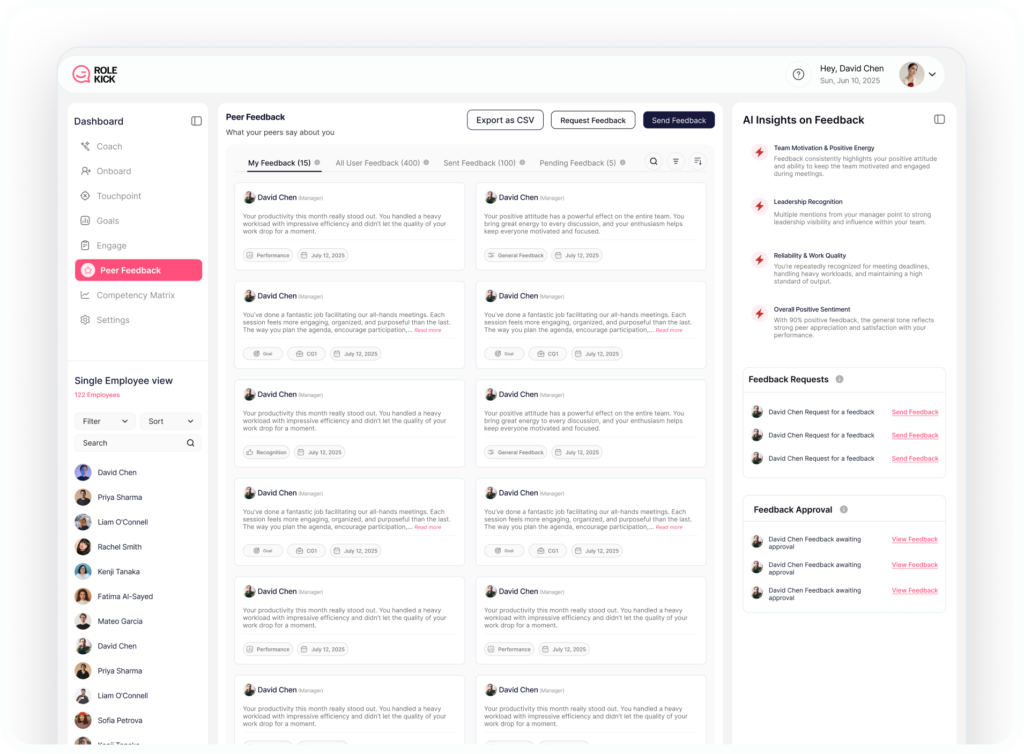
Dedicated Feedback Section
Feedback was separated into its own module to improve discoverability, history tracking, and clarity.
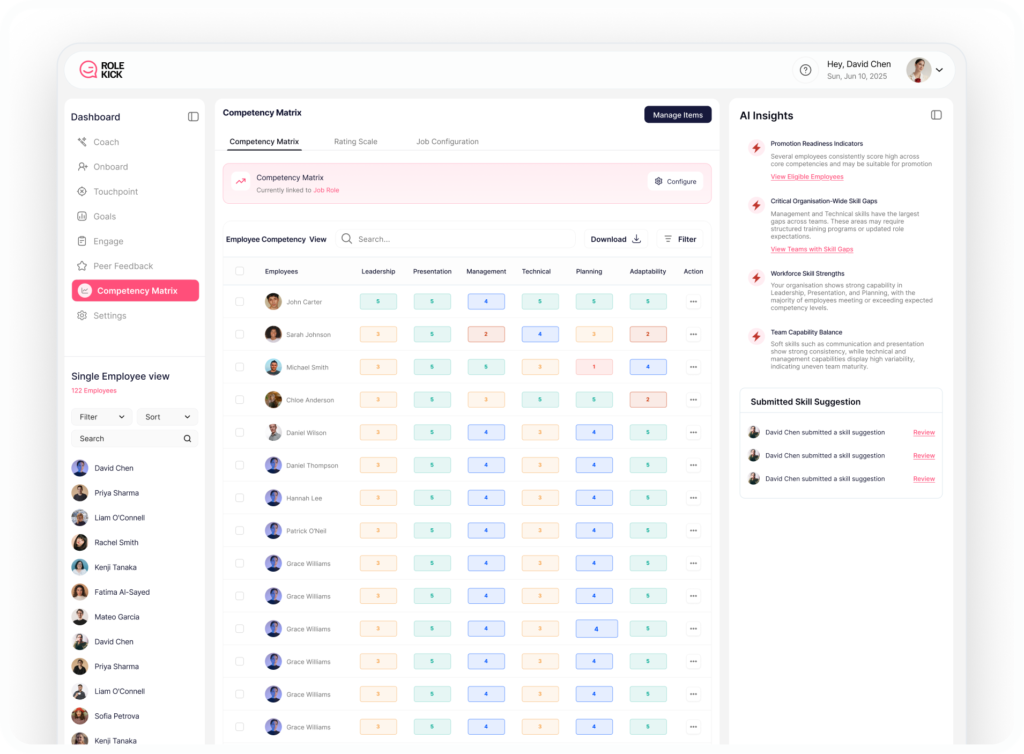
Skill Matrix Module
A competency matrix was added to track strengths and gaps, support talent development, and connect performance to growth.
Impact and Outcomes
Rolekick is currently in active development, but key outcomes include:
1. A cohesive lifecycle based navigation structure
2. Clear role based experiences across HR, manager, and employee users
3. AI coaching integrated into real workflows
4. Web and mobile strategy that protects usability and reduces complexity
The product matured from an engagement focused toolset into a scalable performance and strategy alignment system.
Feedback was separated into its own module to improve discoverability, history tracking, and clarity.
A competency matrix was added to track strengths and gaps, support talent development, and connect performance to growth.
Key Learnings
This project strengthened my ability to design complex multi role platforms, balance business strategy with UX clarity, prioritize under constraints, and integrate AI responsibly into workflow tools.
The biggest lesson:
The best internal tools do not add more features.
They remove uncertainty and give teams clarity to act.